Blog

  • Literature in a Vacuum: The Problem of Ignoring Historical Context

    On the Road Again

    I’m writing to you from the road tonight. This weekend I’m visiting a city with historical and literary significance, and I’ll post a bit about the trip after I return.

    Historical Context Is Important

    In the meantime, I wanted to post a bit about my own high school language arts experience. I was blessed to have a couple of excellent English teachers in high school. But I had a few teachers who did not discuss the historical context of the literature they taught. I didn’t understand until I was older what a huge failure that was. Anyone who teaches literature–public school teachers, homeschooling parents, Outschool teachers–should teach historical context.

    Indulge me while I give you examples from my own high school years.

    • My freshman language arts teacher assumed that her students were well-versed in the French Revolution and the Reign of Terror and did not review those before she taught A Tale of Two Cities.
    • Similarly, my senior AP English teacher did not ask for a show of hands of students with even cursory knowledge about the exploitation and genocide of the Congolese people by King Leopold II before we read Heart of Darkness.

    In both situations, we were advanced-level students, but our school employed coaches as history teachers, the Internet wasn’t yet widely available, and our school library was inferior. The end result: Very few of my classmates understood the full context of those two literary works.

    In contrast, my two favorite English teachers did an excellent job prefacing novels and novellas:

    • My sophomore English teacher set up The Pearl with not only historical context but also John Steinbeck’s personal history.
    • My junior English teacher extensively covered the Puritans and their literature–and even Nathaniel Hawthorne’s family ties to the Salem Witch Trials–before we studied The Scarlet Letter.

    Literature is a reaction to the world. Authors do not write in a vacuum; they respond to history, politics, and current events. The Grapes of Wrath cannot be fully understood without understanding Black Tuesday, the Depression, and the Dust Bowl.  Fully comprehending The Sun Also Rises requires some knowledge about World War I, the Spanish Civil War, and The Lost Generation.  Knowledge of the Civil War and the South post-war inform reading of just about anything by William Faulkner.

    As teachers, we hammer into students that setting is the time and place a literary work occurs. But we sometimes forget that setting has another prong, social milieu, which includes complex information like economic conditions, social classes, and cultural norms. Our students need a prior understanding of history and social milieu to better understand what they are reading.

    This Week’s Printable

    Next week, I’ll publish a printable template that will allow students to map literature and its historical setting on a single page. Enter your e-mail in the box below to join my newsletter, and I’ll send this template straight to your inbox next week.


    Have a great weekend!
    Never stop learning,
    Erin

  • Using Boggle to Teach Morphology/Vocabulary (Includes a Free Word Find!)

    Happy Friday!  Today marks the beginning of my first Friday Archive post.  Every week, I’ll post language arts ideas and resources I used successfully in my classroom and in my own homeschooling.

    Boggle in the Classroom

    A black-and-white photo of an old, damaged Boggle box

    When I taught high school juniors, we played board games after our weekly Friday test.  One of the games we loved most was Boggle.  Sometimes we played as a class; sometimes we played different games–Boggle but also Scrabble, Upwords, etc.–in groups.

    Boggle is better than Scrabble or Upwords in a classroom because it is fast.  You can play a round in a few minutes and then assess who wins just as quickly.  Moreover, Boggle can be used as an incredible motivator if you award bonus points–for my classroom, on that day’s Friday test–to the student with the most words or to the student who forms the longest word or who finds a word that has been in your vocabulary unit or in one of the works of literature you’ve studied.  (I found calculating points this way a lot faster than typical points scoring.)  You can use a standard 4×4 Boggle board, but these days Amazon also offers larger boards of 5×5 (Big Boggle) and even 6×6 (Super Big Boggle).

    I’m including affiliate links below under “Recommended Resources” if you are interested in buying one of these games.  (As an Amazon associate, I earn from qualifying purchases.  The commissions I receive from Amazon help me buy resources to develop this site further.)

    A Less Expensive Option

    A black-and-white photo of a Boggle board and timer

    But if you are on a budget–and right now, who isn’t?–I have another solution.  (Also, this solution is better for “traveling” teachers who don’t have their own classrooms.)

    You can create your own Boggle boards.  I wouldn’t recommend using artificial intelligence to create your own; I’ve tried it, and the words almost never connect because the letters aren’t actually adjacent.  But you can find Boggle board generators on the Internet.  As a teacher, one time I printed Boggle boards on an overhead projector transparency for semi-permanent use (although we all know the ink still rubs off sooner than we’d like), and students would use scrap paper for their lists.  You could also display these without ink or paper in a PowerPoint or on a SMART Board.  These boards can be used with every class, every year.

    Most of my students loved Boggle–provided we didn’t have one student who won all of the games, but I found that situation rare, particularly given the competitiveness of my students and especially where bonus points were involved.  Do you have seven minutes at the end of class?  Did your lesson not last as long as expected?  Boggle is a great filler.

    Literacy Benefits

    By playing Boggle and modeling your own thought processes as you seek to find words yourself, you can guide your students to understand that looking for syllables and specifically roots, prefixes, and suffixes is key to winning Boggles games.  You can even make your own Boggle boards to focus on specific roots or affixes.

    Free Resource:  Boggle/Word Find Board

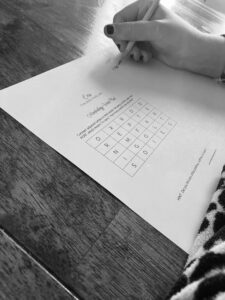
    A black-and-white picture of a student working on a morphology word find

    In fact, I start my vocabulary classes with a Boggle word find that focuses on the root PORT (which means “to carry”).  If you’re interested in a copy of this resource, you’ll need to join my Teacher Workroom newsletter.  Just enter your e-mail address at the link here.  (I promise not to spam you, and you can unsubscribe at any time.)  After you confirm your e-mail address, you should receive a downloadable, printable copy of the board.  The printable will include a permanent link to the solutions for this particular puzzle.  It also includes notes about suffixes you’ll want to highlight and other literacy tidbits–like forming plurals of nouns that end in the letter O and about the word origin of portare.

    I’ll be sending more of these boards for other roots and affixes in the future.  Make sure you subscribe to the mailing list so that you have first access to these!

    Recommended Resources

    As promised, if you’d like to buy an actual Boggle board for your home or classroom, I’m including direct affiliate links below.  (And again, as an Amazon associate, I earn from qualifying purchases.)

    Boggle

    Big Boggle

    Super Big Boggle

    Boggle Vintage Bookshelf Edition

    Any Questions?

    That’s it for today!  If you have any questions, please let me know.

    Never stop learning,
    Erin

  • Why I’m Changing Direction: My Journey from Homeschool Blogger to English Mentor

    For years, I’ve shared with others my homeschooling journey, but my focus has increasingly shifted from general education to the English language.  Language arts has long been near and dear to me; I graduated at the top of my class with a bachelor of arts in English and a minor in education and went on to teach public high school English for several years.  Always a proponent of lifelong education, I also graduated with honors from law school when I was in my early 30’s.  The last few years, I have spent my days homeschooling my own children.

    Now I’m returning to my roots and renewing my teacher certification with an intent to guide students toward high-level mastery of the English language.  My goal is to provide intensive online grammar and vocabulary/morphology instruction for middle school and high school students, particularly for those bound for college.  Starting in June, I plan to hold group bootcamps, intensives, and masterclasses on Outschool, but I am also available for one-on-one tutoring.  I am eager to assist all students, from struggling learners to high achievers.  My goal is for students to leave my classes not just with good grammar but with a more authoritative voice.

    I believe that a mastery of language arts is the centerpiece of a well-rounded education, and thus I am establishing this site to mentor students in this critical subject area.  I am available for homeschooled students as well as for students attending public or private school.

    Never stop learning,
    Erin

    P.S.  Stay tuned for the first entry in my Friday Archive, where I’ll share classroom-tested games and tips to keep high-level English mastery engaging.  Sign up today to receive my first Friday Archive post, plus a special Morphology Masterclass resource I’m currently designing for my subscribers.  You’ll also be the first to know when I open enrollment for my classes this summer.  Enter an e-mail address on this page to subscribe.